

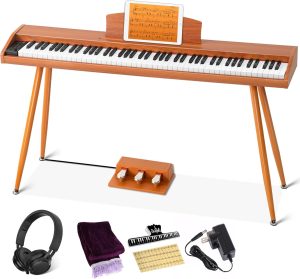
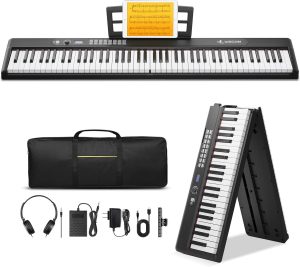
When we first unpacked the piano, its clean white finish and the clever wooden desk design immediately changed the corner of our living room into a small studio. This isn’t just a keyboard with a pretty face; it’s a full-size, 88-key instrument with progressive hammer-action keys that aims to bridge the gap between a beginner-friendly practice tool and a seriously playable home piano. Over the last few weeks we’ve been playing, tweaking, and living with it to see whether it really can be both a piece of furniture and a musical workhorse.
In this review we’ll walk you through how it feels under the fingers, what the exclusive French sound source and eight built-in voices bring to your repertoire, and how the studio-style effects – reverb, chorus and a customizable metronome – shape the overall sound. We’ll also cover practical features that matter for home practice: MIDI and USB connectivity, dual headphone jacks, MP3 playback, and the three-pedal setup for sustain, sostenuto and soft control. And yes, we’ll test that transformable desk/vanity function to see how it fits into real home life.
Our goal is to give a clear, hands-on perspective for anyone considering this piano as their first instrument or as a compact upgrade for their practice space. Expect honest impressions on playability, sound quality, build and everyday usability – plus a few surprises we encountered along the way.
Our First Look and Overall Impression of the Full Size Weighted Home Digital Piano

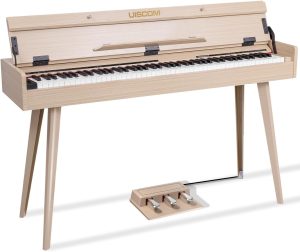
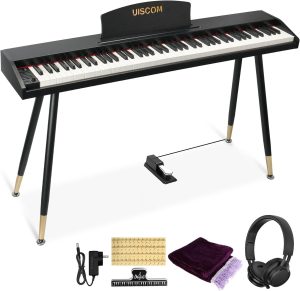
On first glance we were struck by the warm wooden silhouette and how naturally this instrument can sit in a living space – it feels as much like a piece of furniture as it does an instrument. The full 88-key layout with progressive hammer-action immediately convinced us the keys respond with satisfying weight and dynamic nuance, and the built-in three-pedal system adds authentic sustain and expression. In use, the controls are intuitive and the dual headphone jacks make practice sessions private without sacrificing feel. Our quick takeaways include:
- Realistic touch: progressive hammer-action keys
- Home-friendly design: polished wooden finish that blends with decor
- Expressive controls: three dedicated pedals for sustain, sostenuto and soft play
Overall we came away impressed by the balance of studio-grade features and beginner-friendly tools: a French sound source and eight distinct sound profiles give a surprisingly rich palette, while customizable reverb, chorus and metronome let us shape ambiance and timing for practice or performance. Connectivity is thoughtful – USB/MIDI, MP3/hard-drive playback and paired headphone ports mean we can integrate backing tracks or external devices instantly. There’s also a helpful library of 40 practice pieces and adjustable key sensitivity to grow with players as they improve. Quick specs at a glance:
| Feature | Snapshot |
|---|---|
| Sound Engine | French source, 8 tones |
| Practice Tools | 40 pieces + metronome |
| Connectivity | USB/MIDI, MP3 input, dual headphones |
If you want to explore this blend of style and substance for yourself, check pricing and availability here: See it on Amazon
Our Close Examination of the Convertible Wooden Desk and Vanity Design, Progressive Hammer Action and MIDI Functionality

We appreciated how the convertible wooden desk and vanity design doubles as a tasteful piece of furniture and a fully functional instrument, slipping effortlessly into living spaces without shouting “gear.” The progressive hammer-action keyboard gave us a convincing, weighted response that handled soft passages and stronger accents with nuance-especially when we tweaked the key sensitivity to suit our touch. Studio-grade effects like reverb and chorus were intuitive to adjust, and the exclusive French sound source plus the selection of eight sound profiles added color and depth to practice sessions. Our quick highlights:
- Convertible wooden chassis that blends with home décor
- Progressive hammer-action for realistic touch
- Dedicated three-pedal system for sustain, legato and soft play
On the connectivity front, we found the MIDI and USB features genuinely flexible for both composing and performing: the USB interface let us control, play and pause tracks from a connected device, and the unit pairs smoothly with external MIDI devices for broader creative setups. Dual headphone ports made late-night practice distraction-free, while MP3/hard-drive playback allowed us to jam along with favorite recordings. Below is a concise snapshot of the practical benefits we relied on during testing:
| Feature | Benefit |
|---|---|
| MIDI/USB | External control & song playback |
| Dual headphones | Private, uninterrupted practice |
| Effects & presets | Fast sound shaping for expression |
Explore this versatile piano on Amazon
Our Detailed Insights and Specific Recommendations for Setup Practice and Long Term Care Tailored to Beginners

When we set this instrument up for a beginner, our goal is to make the first sessions feel effortless and inspiring. Start by placing the unit on a stable, level surface and connecting power, then plug a laptop or tablet via USB for MIDI control and backing tracks; the integrated USB/MP3 interface makes this seamless. We recommend starting with key sensitivity on a medium setting and then fine‑tuning it to match each student’s touch – the progressive hammer-action responds well to small adjustments. Use the built-in metronome and the library of 40 practice pieces to structure short, focused drills, and experiment with the 8 sound profiles plus subtle reverb/chorus to keep practice engaging without masking technique. For duet or teacher-led lessons, the dual headphone ports are invaluable: one student can practice silently while another listens, or a teacher can demonstrate without disturbing others.
- Initial MIDI/USB: Connect to a DAW or learning app for recording and play‑along control.
- Effects: Apply light reverb/chorus-enough to add warmth but not to hide mistakes.
- Pedals: Test the three-pedal system for sustain/soft/legato right away to learn expressive control.
| Setting | Starter Recommendation |
|---|---|
| Key Sensitivity | Medium → adjust to touch |
| Metronome | Slow → gradually increase |
| Sound Profile | Piano then explore 7 others |
For long‑term care we focus on simple habits that preserve tone and mechanics so beginners keep playing with confidence. Place the instrument away from direct sunlight, heating vents, and humid spots – consistent indoor humidity around 40-60% is ideal to protect internal components and the action. Clean the keys and surfaces regularly with a soft, dry cloth; avoid abrasive cleaners and liquids near jacks and pedals. Check pedal connections periodically and keep cables organized to prevent stress on the ports. We also recommend using a surge protector when powering the unit and storing a lightweight dust cover when not in use to prevent grime buildup.
- Daily: Wipe keys and dust the top.
- Weekly: Plug in and test pedals, ports, and headphone jacks.
- Monthly: Back up MIDI files and review sensitivity/effect settings used in lessons.
Ready to start with a setup that grows with you? Buy on Amazon
Pros & Cons
Pros & Cons
After spending time with this clever desk-by-day, 88-key piano-by-night hybrid, here’s our measured take – the highlights that earn a place in our living room and the trade-offs that are worth knowing before you commit.
Pros
- Smart, stylish design: The wooden desk/vanity transformation blends into a home décor rather than shouting “instrument,” so practice feels more integrated with daily life.
- Realistic feel for learners: Full 88-key progressive hammer-action gives dynamic, graded resistance that helps build proper technique.
- Studio-style tone shaping: Customizable reverb, chorus, and key-sensitivity let us personalize the sound without extra gear.
- Practice- and studio-ready I/O: USB control, MIDI connectivity, dual headphone jacks, and MP3/hard-drive playback make silent practice and simple recording straightforward.
- Performance accessories included: Three dedicated pedals for sustain/legato/soft play add expressive control often missing on beginner boards.
- Learning and sound variety: Eight sound profiles, a French sound source, and 40 practice pieces give learners immediate, useful content.
- Clean aesthetic: The white wooden finish looks fresh and modern in a range of interiors.
Cons
- Footprint when deployed: Transforming it into a full piano takes space – small apartments might feel the squeeze.
- Not a stage grand: While versatile, the onboard speakers and voices won’t fully replace high-end digital grands for pros or recording purists.
- Conversion and setup: The desk-to-piano mechanics add complexity – assembly and switching modes may require patience.
- Limited wireless details: The spec emphasizes USB and MIDI; there’s no clear mention of Bluetooth streaming, which could disappoint those wanting seamless wireless audio.
- Targeted at beginners/enthusiasts: Advanced pianists seeking boutique sampled libraries or ultra-high-fidelity outputs may outgrow it.
| Top Pros | Top Cons |
|---|---|
| Elegant convertible design | Large footprint when open |
| Authentic progressive hammer action | Speakers not studio-grade |
| MIDI/USB + dual headphone ports | No explicit Bluetooth streaming |
Overall, we find this instrument a compelling pick for home musicians who value aesthetics and a realistic keyboard feel. It’s a thoughtful balance of style and function – especially strong for beginners and home studios – but we’d advise larger homes or serious players to weigh the sonic limits and space needs before buying.
Q&A
Q: What exactly is the “88 Key Weighted Home Digital Piano” in plain terms?
A: It’s a hybrid piece of furniture and instrument – a wooden desk/vanity that converts into an 88-key digital piano with progressive hammer-action keys. In other words, it looks like a stylish desk during the day and becomes a full-sized weighted keyboard for practice or performance by night.
Q: Is this piano a good choice for beginners?
A: Yes. It was clearly built with learners in mind: an 88-key layout with progressive hammer-action, 40 built-in practice pieces, adjustable key sensitivity, a metronome, and studio-style effects that help shape tone as students progress.
Q: Are the keys truly “weighted”?
A: The product uses progressive hammer-action, which simulates the weighted feel of an acoustic piano – lighter in the high register, heavier in the low – so it’s a realistic touch for developing proper technique.
Q: How does the desk-to-piano transformation work?
A: The listing describes it as a transformable wooden desk/vanity that becomes a piano. Exact mechanics (folding lid, removable panels, etc.) aren’t detailed in the description, so we recommend checking the product photos, assembly guide, or seller notes for the step-by-step process and space requirements.
Q: What kinds of sounds and effects does it offer?
A: The piano includes a French sound source and eight precision-crafted sound profiles. It also provides studio-style effects such as customizable reverb and chorus, plus metronome settings – useful for shaping tone and practicing dynamics.
Q: Can we connect external devices (MIDI, MP3, etc.)?
A: Yes. It supports MIDI connections (via USB) so you can hook it to DAWs and external gear. There’s also an integrated USB interface for playing or controlling MP3s and data from a drive, according to the description.
Q: Is this suitable for silent practice?
A: Absolutely. There are dual headphone ports so two people can practice privately, and you can switch off the speakers for quiet sessions.
Q: What pedal functions are available?
A: The unit has a dedicated three-pedal system, letting you work with sustain and nuances like legato and soft play. The description highlights sustain and expressive control, so it’s set up for more than basic on/off sustain.
Q: How easy is it to set up and maintain?
A: The product is presented as a furniture-style instrument, so some assembly is likely and we suggest reading the included manual before purchase. For upkeep, treat the wooden exterior like other furniture – avoid direct sunlight and excessive humidity, and follow the manufacturer’s care recommendations.
Q: Is it portable?
A: Not really. Because it doubles as a wooden desk/vanity and houses an 88-key action and speaker system, it’s best thought of as a stationary home instrument rather than a gig-friendly portable keyboard.
Q: Who should consider buying this piano?
A: It’s a solid match for beginners and home players who want realistic keyboard feel plus the convenience of a furniture-style design. It’s also appealing to people who value a discreet, attractive instrument that blends into living spaces.
Q: Any caveats or things to check before buying?
A: Yes. Confirm dimensions and weight for your space, verify what’s included (pedals, power cables, any assembly hardware), and check warranty and return policies. If you need specific features like split/dual-voice modes, detailed polyphony counts, or studio output power, look for those specs on the seller page or ask the manufacturer directly – they’re not spelled out in the summary we were given.
Q: Where can we get more detailed technical info or support?
A: Check the full product listing, downloadable manual, or seller/manufacturer support. If exact specs aren’t listed, contact the vendor to confirm items like polyphony, speaker wattage, assembly instructions, and warranty terms before ordering.
Embrace a New Era

We’ve enjoyed exploring how this 88-key, progressive hammer-action piano slips seamlessly between a stylish wooden desk and a full-size digital piano by night. For us, the charm is in the balance: a clean, white vanity that houses studio-grade features – customizable reverb and chorus, adjustable key sensitivity, a French sound source and eight sound profiles – without sacrificing the realism of weighted keys. The integrated USB and MIDI connectivity, dual headphone jacks, and three-pedal system make it useful for both focused practice and quiet, immersive sessions.
If you’re starting out, the built-in 40 practice pieces, metronome and easy MP3 playback mean fewer barriers between curiosity and progress. If you’re setting up a small home studio, the personalization options and external device compatibility give you room to grow. We found the transformation from furniture to instrument intuitive, and the overall package thoughtful for a home environment where space and aesthetics matter.
We’re not saying it’s perfect for every player, but for those who want a tasteful piece of furniture that doubles as a serious learning instrument – with room to experiment and connect – this piano is worth a close look.
See current price and availability on Amazon: Check the 88 Key Weighted Home Digital Piano on Amazon
Reviews
There are no reviews yet.