

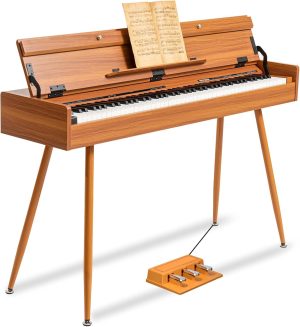
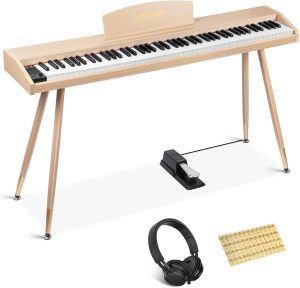
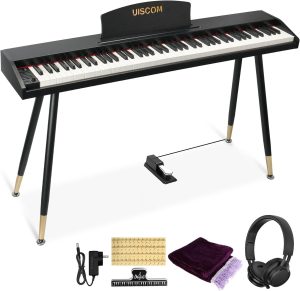
We don’t usually gush about furniture, but the first time we rolled the apricot-finished desk piano into our living room it quietly changed the whole space. From a distance it reads like a tasteful wooden desk or vanity – the wood-grain texture really does blend with home décor – and up close it behaves like a proper 88-key piano. In our hands it transformed from a neat piece of furniture into a full-sized instrument in seconds, which made both afternoon practice and late-night noodling feel effortless and unobtrusive.
Sitting down to play, the progressive hammer-action keys and the triple pedal setup (sustain, sostenuto, soft) gave us an immediate sense that this wasn’t a toy keyboard. The weighted action responds with noticeable gradation across the keyboard, and the onboard French Dream5704 sound engine supplies lush tones across eight presets. We enjoyed experimenting with reverb, chorus, and the metronome while looping through the 40 built-in demo songs – and the dual headphone jacks, USB MP3 playback, and MIDI connectivity made it easy to practice privately or hook up to our computer for recording and customization.
In this review we’ll walk you through our hands-on impressions of build quality, key action, sound realism, pedals, and the piano’s practical features like recording, MP3 playback, and MIDI. We’ll also cover setup, who this instrument suits best, and any trade-offs we noticed during extended use. If you’re curious whether this wooden desk-style digital piano can be your practice companion and a stylish piece of furniture, read on – we put it through its paces so you don’t have to.
Our Overview and First Impressions of the 88 Key Weighted Home Digital Piano

Our first encounter was unexpectedly pleasant – the warm wood-grain finish blends into our living space so well that the instrument reads like a stylish desk or vanity rather than a bulky keyboard. Under the lid, the progressive weighted hammer-action keyboard gives a convincing acoustic-like resistance across the full 88 keys, and the three-pedal system (sustain, sostenuto, soft) adds expressive nuance that makes practice feel purposeful from day one. Sonically, the piano surprised us: the French Dream5704 sound source delivers a full, emotional tone across the onboard voices, and the combination of 8 distinct tones and 40 demo songs gives ample material for beginners to learn and for more experienced players to test different textures. Highlights we kept returning to:
- Furniture-grade aesthetic that suits home décor
- Realistic touch thanks to progressive hammer action
- Expressive pedals for nuanced practice
- Rich core sound from the French sound chip
Operating the instrument felt intuitive: dedicated power and volume controls, easy tone switching, and studio-style effects like reverb and chorus help shape our sound quickly, while the built-in USB/MP3 playback and dual headphone jacks make private practice and backing-track playbacks seamless. MIDI connectivity and adjustable key sensitivity open doors for learning apps and DAW integration, and the simple record function lets us capture progress without extra gear. Quick specs at a glance:
| Feature | Snapshot |
|---|---|
| Keys | 88 progressive weighted |
| Voices | 8 presets |
| Pedals | Sustain / Sostenuto / Soft |
| Connectivity | MIDI, USB, dual headphone jacks |
If you’re curious to hear that French sound chip and test the desk-to-vanity styling in your own space, take a closer look here: See current price and details on Amazon
How the Transforming Wooden Desk Design and Progressive Hammer Action Keyboard Fit Our Home and Practice Needs

We immediately noticed how the wood-grain finish and transforming desk design let the instrument disappear into our living space when we weren’t practicing – it looks like a piece of furniture rather than a clunky keyboard. The progressive hammer-action keyboard gives weight and responsiveness that help us develop proper touch from day one, while the built-in three-pedal system (sustain, sostenuto, soft) adds expressive nuance without requiring extra floor space. With the integrated power switch and volume knob, two headphone jacks for late-night practice, and a USB MP3 player for play-along tracks, it serves both as an elegant desk and a focused practice station that fits our routines and aesthetic. Practical for small homes, welcoming for beginners, and solid enough for steady progress.
- Blends with décor: wood-grain desk/vanity transformation
- Authentic feel: progressive weighted keys & adjustable key sensitivity
- Practice-ready: triple pedals, dual headphones, and USB playback
- Expandability: MIDI connectivity for lessons and DAW use
When we sit down to practice, the sound engine stands out – a rich, expressive tone from the French sound source, plus eight selectable voices and 40 built-in demo/practice songs that keep our sessions varied and productive. Studio-style effects like reverb and chorus, tempo/metronome controls, record-and-playback, and a handy dual-tone mode let us shape phrasing and timing as we learn, while MIDI output connects effortlessly to apps and recording software for more advanced study. Below is a quick snapshot of how the key features translate into real practice benefits for our household.
| Feature | Why it helps us |
|---|---|
| French sound chip | Warm, expressive tones that inspire daily practice |
| 40 demo songs | Built-in repertoire for guided learning |
| MIDI & USB | Connects to apps, DAWs, and learning tools |
| Three pedals | Realistic control of sustain and dynamics |
See current price and details on Amazon
Our Detailed Insights and Practical Recommendations for Beginners Using MIDI and Setting Up at Home

We appreciate how quickly the instrument becomes a practical home centerpiece thanks to its warm wood-grain finish and convertible desk/vanity silhouette, and we recommend using that aesthetic advantage when planning placement – a clear sightline and comfortable bench height improve practice sessions as much as the hardware. For beginners exploring MIDI, start by toggling key sensitivity to a medium setting so dynamics respond without overwhelming control, then connect via USB to a laptop or tablet to record performances or use soft-synths. Balance realism and convenience by using the progressive weighted hammer-action for technique development, the triple pedal system to practice sustain and expression, and the built-in MP3/USB playback for play-along tracks. Practical steps we follow when setting up at home:
- Set key sensitivity to Medium, then tweak as your touch improves.
- Use dual headphone jacks for quiet, focused practice or shared lessons.
- Start with the piano tone from the French Dream5704 sound chip, then explore other tones slowly.
- Keep reverb and chorus subtle while learning; add effects as you gain confidence.
- Use the metronome and two of the 40 demo songs for structured warm-ups.
| Setting | Beginner Recommendation |
|---|---|
| Key Sensitivity | Medium |
| Reverb/Chorus | Low |
| Metronome Tempo | 60-80 BPM |
| Pedal Use | Sustain only, then add sostenuto/soft |
We also suggest labeling ports and keeping a short USB cable handy for quick MIDI connections; the volume knob and power switch make on-the-fly adjustments simple during lessons or late-night practice. Ready to set up your own practice-friendly workstation? Explore current price and details
Pros & Cons

Pros & Cons
We weighed the highlights and trade-offs so you can decide if this 88-key desk piano suits your home and learning goals. Below are the strengths that impressed us and the caveats we noticed during our hands-on impressions.
| Pros | Cons |
|---|---|
|
|
Our bottom line: We love the concept – a full 88-key weighted instrument that looks like furniture and offers useful studio-style features for home practice. It’s a smart pick for beginners and style-conscious players who value pedals, MIDI, and built-in playback. If you’re chasing the deepest sampled piano tones or need a truly compact travel keyboard, this model may ask for some compromises.
Q&A

Q: Does this really work as a desk or vanity, or is that just marketing?
A: The piano’s wood-grain finish and low-profile cabinet are clearly designed to blend into a living space as a desk or vanity. In practice it reads like furniture when closed or styled, so it’s a great option if you want an instrument that doesn’t scream “studio.” For exact conversion mechanics (folding lid, removable components, weight-bearing top), we recommend checking the seller’s assembly guide or asking customer support-manufacturers sometimes vary on the hardware and load limits.
Q: How authentic does the keyboard feel?
A: It uses a progressive weighted hammer-action keyboard, which means the lower keys feel heavier and the higher keys lighter-an approach that mimics an acoustic piano’s touch. For beginners and many intermediate players this is a strong step toward realistic technique. If you’re a concert pianist seeking grand-piano action or key-bed materials, you may want to try one in person first.
Q: What about sound quality?
A: The piano is powered by the French Dream5704 sound chip and offers 8 distinct tones. In our experience, that combination provides a rich, expressive core sound-especially with the onboard reverb and chorus to add depth. It’s studio-capable for home practice and hobby recordings, though absolute fidelity will depend on speaker placement and room acoustics.
Q: Are the pedals useful?
A: Yes. The included triple-pedal system supports sustain, sostenuto, and soft functions-important for developing expressive technique. The hardware gives you the same kinds of articulation you’d use on an acoustic piano, which is a big plus for students working on dynamics and pedaling.
Q: How do the MIDI and recording features perform?
A: MIDI functionality is built in, so you can connect to a computer or external MIDI gear to control virtual instruments, record MIDI tracks, or change key sensitivity. The instrument also has a record function to capture performances internally. As with most digital pianos, latency is minimal when properly configured, but we advise using a quality USB cable and checking DAW/audio driver settings for tightest timing.
Q: Can I play along with tracks or use MP3 files?
A: Yes. There’s an integrated USB interface that supports MP3 playback from USB drives and provides basic play/pause control. Dual headphone jacks let two people practice privately, which is handy for teachers and students.
Q: How many demo songs and voices does it have?
A: The unit includes 40 demo songs and 8 preset tones. These are useful for practice and exploring different voicings, though more advanced players may want to use external sound libraries via MIDI for extra variety.
Q: Is it beginner-friendly?
A: Absolutely. The progressive hammer action, triple pedals, built-in demo songs, metronome, and adjustable key sensitivity make it well suited for beginners and motivated learners. The furniture-style design also encourages consistent practice in a living-space setting.
Q: What about connectivity and controls?
A: Controls are intuitive-tone select, dual-tone mode, record, reverb, chorus, tempo, and a simple power/volume layout. There’s a built-in USB port for playback and MIDI over USB for DAW or app connections. Two headphone jacks are included for private practice.
Q: How big and heavy is it? Will it fit in my room?
A: The product is a full 88-key instrument presented in a desk-style cabinet, so expect piano-sized dimensions and corresponding weight. It’s less portable than a slim stage keyboard but designed to function as furniture. We suggest measuring your intended space and checking the product listing for exact dimensions and weight before ordering.
Q: Any tips for setup and care?
A: Place it on a stable, level surface away from direct sunlight and extreme humidity to protect the wood-grain finish and electronics. If assembly is required, follow the manual carefully-having a second person helps with larger cabinet pieces. For cleaning, use a soft, dry cloth; avoid harsh solvents on the finish.
Q: How about warranty, support, and returns?
A: The listing doesn’t specify warranty details in the description provided. We always recommend confirming warranty length, return window, and spare-parts/support policy with the seller before purchase-especially for electronics that may need service.
Q: Who is this piano best for, and who should consider alternatives?
A: Best for beginners to intermediate players who want authentic-feeling keys, expressive pedals, and a home-ready piece of furniture that doesn’t dominate a room. If you need ultra-high-end sampled piano engines, concert-level action, or a lightweight travel instrument, consider specialty digital pianos or stage keyboards instead.
Q: Any final thoughts?
A: We appreciate the blend of form and function here: a progressive hammer-action 88-key instrument that looks like furniture, with solid connectivity (MIDI, USB, headphone jacks), a triple-pedal system, and studio-style effects. It’s an appealing option for anyone who wants a real-piano experience that fits into a living room or bedroom without compromising décor. Always double-check dimensions, warranty, and specific hardware details with the seller to make sure it matches your space and workflow.
Transform Your World

As we wrap up, our verdict is simple: this 88-key desk piano is a clever hybrid for anyone who values both sound and style. The wood-grain finish and convertible desk-to-vanity design make it at home in living spaces where an upright piano would look out of place, while the progressive hammer-action keys, triple pedals, and French Dream5704 sound source deliver a genuinely playable experience. We appreciated the MIDI connectivity, studio-style effects, built-in MP3/USB playback, and dual headphone jacks-features that make it equally suitable for curious beginners and focused hobbyists.
It won’t replace a concert grand, and serious pianists may still prefer dedicated stage or studio instruments, but for what it is-a functional piece of furniture that invites practice and creativity-it strikes a compelling balance. If you’re furnishing a small space or want an attractive, expressive instrument that doubles as décor, this model deserves a spot on your shortlist.
Ready to explore further? See price & details on Amazon
Reviews
There are no reviews yet.