

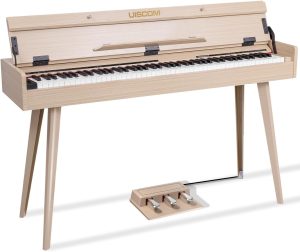
When a digital piano promises to be both an instrument and a piece of furniture, our curiosity was piqued – so we spent time with the 88 Key Weighted Digital Piano – Wooden Desk Electric Piano Transforms Between Desk and Vanity to see whether it could really pull double duty. At first glance it strikes a neat balance between living-room elegance and studio functionality: a wooden desk that reveals a full-sized, progressive hammer-action keyboard built for beginners but outfitted with features that ambitious players will appreciate.
In our hands the keyboard’s weighted feel and progressive hammer-action stood out immediately – keys that respond differently across the range bring a surprising amount of nuance to simple practice sessions. The French Dream5704 sound chip is the engine behind the tone, and we were impressed by the depth and clarity across the eight onboard voices and 40 demo songs. Beyond sound and touch, the piano’s versatility became evident: dual-tone mode, reverb and chorus controls, recording/playback, and convenient MP3/USB playback make it more than a basic practice tool.
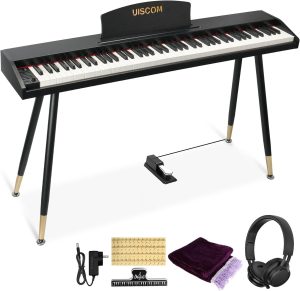
We also tested the MIDI functionality and the triple pedal setup. The MIDI connectivity opened up creative workflows when linked to our DAW and external devices, while the sustain, sostenuto, and soft pedals added expressive control that beginners don’t always get with entry-level boards. Practical touches – a power switch and volume knob, dual headphone jacks, an integrated MP3 player, and a built-in USB port – kept everyday use simple and intuitive.
In the full review we’ll break down performance, build quality, ergonomics, and value for money, and we’ll share where this hybrid piano shines and where it leaves room for improvement. If you’re juggling space, style, and a desire to learn or create, our hands-on experience should help you decide whether this convertible wooden piano belongs in your home.
Our Overview and First Impressions of the Eighty Eight Key Weighted Digital Piano That Transforms Between Desk and Vanity

Our first impression is that this instrument balances aesthetics and practicality in a way that feels intentional – the wooden chassis slides smoothly from a compact desk silhouette into a vanity-style cabinet, giving us a stylish piece of furniture that also invites playing. The keys have a satisfying progressive hammer-action weight that responds well to dynamics, and the custom triple pedals (sustain, sostenuto, soft) immediately add expressive nuance. Sonically, the French Dream5704 chip gives a warm, resonant tone across the range; with 8 selectable voices and 40 demo songs we found plenty of inspiration for practice and small performances. We also appreciated the tactile convenience of the power switch and volume knob: straightforward to operate whether we’re practicing late at night through headphones or sharing sound out loud.
Feature-wise, the controls and connectivity make this a versatile option for beginners who want room to grow: MIDI functionality and adjustable key sensitivity open simple pathways to DAWs and external devices, while the onboard recorder, dual-tone mode, reverb/chorus/tempo adjustments, and MP3 playback from USB make everyday use feel polished. Highlights we kept returning to include:
- Versatile control – quick tone switching, layered sounds, and recording/playback.
- Connectivity – dual headphone jacks, USB MP3/hard drive support, and MIDI ports.
- Performance tools – responsive hammer action and expressive triple pedals.
| Quick Specs | Takeaway |
|---|---|
| Sound Chip | French Dream5704 – warm, immersive |
| Tones / Demos | 8 voices • 40 songs |
| Extras | USB MP3 • Dual jacks • MIDI |
Our overall feeling is that this unit is beginner-friendly without feeling limiting – it’s a functional instrument and a stylish piece of furniture that encourages practice. Check current price on Amazon
We Highlight the Progressive Hammer Action Keyboard, MIDI Capabilities, Sound Engines, and Wooden Desk Craftsmanship

We especially appreciate the Progressive Hammer Action keyboard for the way it mimics an acoustic touch – heavier in the low end and lighter at the top – giving us a realistic feel that supports expression and practice. Coupled with the French Dream5704 sound chip, the voices have a surprising depth: 8 distinct tones and 40 demo songs give us plenty of variety to explore. The onboard controls make customization straightforward: we can switch tones, enable dual‑tone layering, tweak reverb, chorus, and tempo, and use the built‑in recorder/playback to track progress. MIDI connectivity expands our creative options, allowing us to alter key sensitivity and link to external devices and software for composition or learning.
- Expressive touch: progressive hammer keybed
- Sound palette: 8 tones, 40 demos
- Performance tools: dual‑tone, recorder/playback, reverb/chorus
- MIDI: external device control and DAW integration
| Feature | Quick Detail |
|---|---|
| Sound Chip | Dream5704 |
| Tones | 8 |
| Demos | 40 |
Beyond the keyboard, we love the thoughtful wooden desk craftsmanship that lets the unit transition between a functional workspace and an elegant vanity piece without sacrificing performance. The integrated conveniences-power switch and volume knob for quick adjustments, an MP3 player with USB/hard drive playback, and dual headphone jacks-make practicing and sharing effortless. The included special triple pedals (sustain, sostenuto, soft) provide nuanced control for expressive playing, while the sturdy wooden finish blends studio utility with home décor.
- Design: transforms between desk and vanity
- Playback & storage: USB/MP3 player and hard drive support
- Monitoring: dual headphone outputs
- Pedals: sustain, sostenuto, soft
Our Detailed Insights and Practical Recommendations for Beginners, Home Studios, and Space Savvy Players

We approached this instrument from three angles-beginners, home studios, and players with limited space-and came away impressed by how much it packs into a compact, convertible form. The progressive hammer-action keys give a realistic touch that helps developing technique, while the French Dream5704 sound chip delivers depth across the built-in tones and demo library. For everyday convenience it offers intuitive controls (power switch, volume knob), an integrated MP3 player via USB, dual headphone jacks for silent practice, and a simple recording/playback workflow-features that make practice, sharing, and improvement effortless. Our practical tips:
- Sound & Expression: Use reverb and chorus sparingly to add warmth without washing out dynamics.
- MIDI & Learning: Activate MIDI to connect lessons or DAWs-adjust key sensitivity to match your touch.
- Pedal Use: Emphasize the triple pedals-sustain for phrasing, sostenuto for advanced repertoire, soft pedal for color.
- Shared Practice: Dual headphone outputs are ideal when teaching or practicing with a partner.
To help decide how to set it up in your space, we summarized practical configurations for each user type. The table below shows quick settings and benefits we recommend for fast results in the home or studio environment.
| User | Recommended Settings | Quick Benefit |
|---|---|---|
| Beginner | Medium key sensitivity, piano tone, reverb low | Better feel, clear tonal focus |
| Home Studio | MIDI out, dual-tone, record enabled | Easy DAW integration and layering |
| Space-Savvy Player | Compact desk mode, headphone practice | Saves floor space, silent hours-friendly |
We recommend placing the instrument where you’ll sit daily-consistency beats occasional marathon sessions. Ready to try the setup we tested? Check it out on Amazon
Pros & Cons

Pros & Cons
After playing, recording, and living with this 88-key weighted desk-to-vanity piano for a few weeks, here’s how we’d sum it up – the highlights that won us over and the trade-offs you should know before buying.
Pros
- Authentic touch: Progressive hammer-action keys give a convincing acoustic-like feel that’s excellent for beginners and practice.
- Smart dual-purpose design: The wooden desk/vanity conversion is creative and space-saving – a piano that doubles as furniture.
- Great connectivity: MIDI functionality and USB/MP3 playback open up home recording and DAW use without fuss.
- Expressive control: Triple pedals (sustain, sostenuto, soft) and adjustable key sensitivity let us shape dynamics and phrasing.
- User-friendly features: Built-in recorder/playback, dual headphone jacks, and simple volume/power knobs make everyday use easy.
- Warm sound engine: The French Dream5704 chip produces a rich, immersive tone and the included tones and demo songs are useful learning tools.
Cons
- Limited tone palette: Only 8 onboard tones – fine for practice, but less variety than higher-end digital pianos.
- Speakers have limits: Onboard sound is pleasant in small rooms; it won’t replace an amp or fill large spaces with the same presence.
- Heavier / less portable: The wooden furniture design looks great but adds weight – not ideal if you move frequently.
- Minor interface fiddliness: Menu navigation and parameter tweaks (reverb/chorus/tempo) are functional but can feel a bit clunky compared with touchscreens.
Quick snapshot
| Why we liked it | What gave us pause |
|---|---|
| Realistic weighted action for practice | Only a handful of built-in tones |
| Converts to a tasteful desk or vanity | Not designed for frequent transport |
| MIDI + USB recording and playback | Speakers best for small rooms |
| Triple pedals add expressive control | Controls can be fiddly to dial in |
Overall, we found this piano to be an inspired hybrid – excellent for students, apartment players, and anyone who wants a piece of functional furniture that also sounds and feels like a proper instrument. The trade-offs are mostly about portability and advanced sound variety, not core playability.
Q&A

Q: What exactly do we mean by “desk-to-vanity” – how does the transformation work?
A: The piano is designed to double as furniture: when not in use the keyboard sits behind a finished wooden top so the unit looks and functions like a desk or vanity. Transforming it for play simply means revealing the keys and using the stand/legs that form the piano’s working height. The conversion keeps the instrument discreet and makes it a practical choice for multi-use rooms.
Q: How do the keys feel – is the weighted action convincing?
A: The keyboard uses progressive hammer-action, so bass keys feel heavier and treble keys lighter, which mimics an acoustic piano’s response. We found it gives real resistance and dynamics suitable for developing touch and expression, especially for beginners progressing into intermediate technique.
Q: How does the sound quality compare to other digital pianos?
A: Sound is driven by the French Dream5704 chip. In our listening tests the tones are full-bodied and musical with pleasant resonance. There are 8 distinct tones, and the built-in reverb/chorus controls let you shape the ambiance. It isn’t a concert grand replica, but for home practice and small performances it is very satisfying.
Q: Are the built-in speakers loud and clear enough for everyday use?
A: Yes – the onboard speakers provide clean sound for practice and casual listening. For late-night practice, the dual headphone jacks are a great option and allow two people to play silently together.
Q: What can we do with the MIDI functionality?
A: MIDI opens a lot of doors: you can connect the piano to a computer, use it as a controller in a DAW, trigger virtual instruments, and adjust key sensitivity for different playing feels. It’s great for learners who want to use lessons software and for players who want to expand into music production.
Q: How does the recording/playback feature work?
A: The unit offers onboard record and playback, so you can capture performances directly on the instrument to review practice sessions or demo ideas. There’s also MP3 playback from USB/hard drive, so you can play along with backing tracks or demo songs.
Q: Are the pedals any good?
A: The piano ships with a custom triple-pedal unit that provides sustain, sostenuto, and soft functions. We found them responsive and helpful for expressive playing – a definite step up from single-pedal setups often bundled with entry-level keyboards.
Q: Is this piano suitable for beginners?
A: Absolutely. The weighted, progressive hammer-action keys build good technique from the start, the onboard lessons/demo songs help users get going, and the instrument’s controls are user-friendly. MIDI and connectivity mean it can grow with a student who wants to explore software and recording later on.
Q: How easy is it to use the controls and change sounds?
A: The control layout is straightforward. You can switch tones, enable dual-tone (layering two sounds), apply reverb or chorus, adjust tempo, and use the MP3 player and volume knob with minimal fuss. It’s intuitive once you spend a few minutes exploring the panel.
Q: Can we use our own backing tracks or MP3s?
A: Yes – there’s a built-in MP3 player and a USB port for MP3 or hard drive playback, so you can load and play your own tracks directly from a USB device.
Q: What do we need to connect to a computer or DAW?
A: Use the piano’s MIDI/USB connection to link it to a computer or audio interface. Depending on your DAW and setup, you may need a USB-MIDI cable or standard USB cable. Once connected you can send MIDI note data to virtual instruments and record performances.
Q: Does it come with a bench or assembly required?
A: As a furniture-style instrument, some assembly is typically required. The product is sold as a desk/piano unit and will need to be set up; check the seller details for whether a bench is included. We recommend having basic tools and a helper for safe assembly.
Q: Is it good for duet practice or classroom use?
A: Dual headphone jacks and the solid tonal response make it well-suited for duet practice, paired lessons, or situations where two people want private listening. For heavy classroom use, consider the build and warranty specifics from the seller.
Q: Any downsides or things to be aware of?
A: The instrument balances furniture design with musical functionality, so if you need a professional stage instrument or a full-weight concert action, a higher-tier digital or acoustic piano may be preferable. Also, sound and feature performance can depend on firmware and setup – using quality cables and keeping drivers/firmware updated improves MIDI latency and compatibility.
Q: What accessories do we recommend?
A: A comfortable adjustable bench, a surge protector/power conditioner, a reliable USB/MIDI cable for DAW work, and a dust cover if you leave it in music mode frequently. If you plan to record, an audio interface and good headphones or studio monitors will expand your options.
If you have specific questions about dimensions, warranty, or explicit setup steps, tell us which detail you need and we’ll dig into it for you.
Experience the Difference

After spending time with the 88 Key Weighted Digital Piano in its desk and vanity configurations, we’re left with a clear sense of what it offers: a thoughtful blend of form and function. The progressive hammer-action keys and triple pedals give our playing more nuance than a typical compact keyboard, while the French Dream5704 sound core, eight tones, and 40 demo songs provide a rich sonic starting point. The MIDI support and MP3/USB playback expand how we create and practice, and the dual headphone jacks, intuitive controls, and transformable wooden desk design make it equally at home in a studio corner or on our bedroom vanity.
This isn’t a one-size-fits-all instrument, but for beginners and hobbyists who want an expressive, space-savvy piano that doubles as furniture, it’s a compelling package. We appreciated the mix of convenience and musical features; if you value versatility and feel, this is worth a closer look.
See current pricing and full specs on Amazon:
View the 88 Key Weighted Digital Piano on Amazon
Reviews
There are no reviews yet.